Skip to content
Guide · Dock know-how

How to hire a dock builder

Updated

10 min read
Get three written quotes on the same drawing, check each builder’s license and insurance, look at docks they’ve built on water like yours, and never pay most of the price up front. Here’s each step, plus fair payment terms and red flags.
On this page
01

What a dock builder does

“Dock builder” covers one-crew outfits and firms with barges and pile drivers. Who does what:

Who builds and sells docks
  • Dock builder
    What they do
    Designs, builds and repairs residential docks, lifts and accessories. Often handles permits.
    Call them when
    You want a dock built, rebuilt or repaired.
  • Marine contractor
    What they do
    Pile driving, seawalls, dredging, commercial piers and marinas.
    Call them when
    Deep or tidal water, a seawall, barge work.
  • Dock manufacturer
    What they do
    Makes dock systems and sells through dealers.
    Call them when
    You’ve picked a brand.
  • Dealer
    What they do
    Sells and installs manufactured systems, often seasonally.
    Call them when
    You want a manufactured dock or lift put in.
  • Engineer
    What they do
    Designs and stamps structures when required.
    Call them when
    A stamped drawing is required.

Not sure which dock type your water needs? Read floating vs fixed vs hybrid first.

02

When to start

Give yourself months. Permits run on each agency’s clock — Washington’s fish and wildlife agency typically takes up to 45 days once an application is complete[5] — and builders schedule around seasons and water levels.

A workable order:

  • Decide what you want.
  • Draw it so every builder prices the same thing.
  • Find out who issues permits (see dock permits).
  • Get quotes, ideally before builders’ busy season.
  • Sign, permit, build, in that order.
03

Where to find dock builders

  • Docks you like on your lake. Ask who built them and how they’ve held up. A dock that looks good after several winters is the best reference.
  • Your lake association or marina. They know which crews work your water.
  • Manufacturer dealer lists, if you’ve already chosen a dock or lift brand.
  • Builders’ own websites. Some let you design your dock on their site and send it straight to them for a quote. Jake On The Lakes in Coeur d’Alene, for example, runs its designer at build.jakeonthelakes.com.
04

How to vet a dock builder

The FTC’s advice applies: consider only licensed and insured contractors, get recommendations, and check for complaints[1]. For a dock:

  • License. Verify any required license with the agency that issues it.
  • Insurance. A liability certificate (and workers’ comp) from their agent.
  • Docks they’ve built. Ask for two or three past customers and go look, ideally on water like yours.
  • Your dock type. Ask how many like yours they built last year.
  • Permits. Ask who draws and who applies. Asking you to get the permits is an FTC warning sign[1].
  • Warranty. Workmanship in writing, plus manufacturers’ warranties.
  • A written contract with name, license number, dates, scope and price[1] — more in what a dock quote should include.
05

Send every builder the same plan

Blind quotes are hard to compare: the cheaper number may just be the smaller dock. Fix the design first and every quote prices the same thing.

  1. Step 1: Draw your dock — free, no account

    Lay out sections, L, T or U shapes, gangways and lifts on your phone or computer.

    Free designer · signed out (demo)
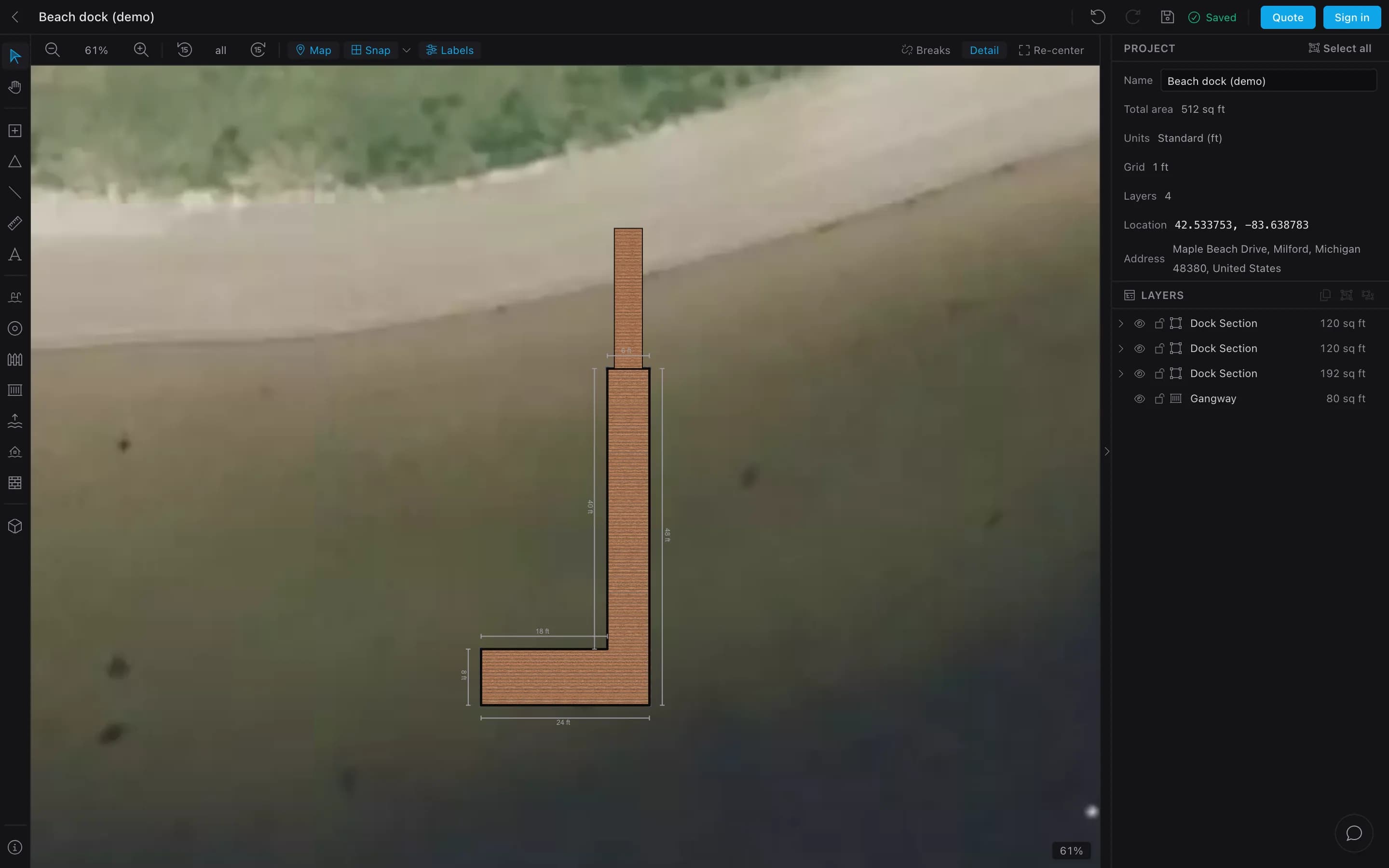
    Dock Builder’s free designer, signed out: an L-shaped dock and a gangway drawn on a satellite view of a beach, the Quote and Sign in buttons top right, and the Project panel with total area 512 sq ft and four layers.
    Sections, L, T or U shapes, gangways and lifts — no account. Quote and Sign in sit top right.
  2. Step 2: Free account: material list and printable plan

    A free account (just an email) adds the take-off and a scaled PDF.

    Material take-off · joists (demo)
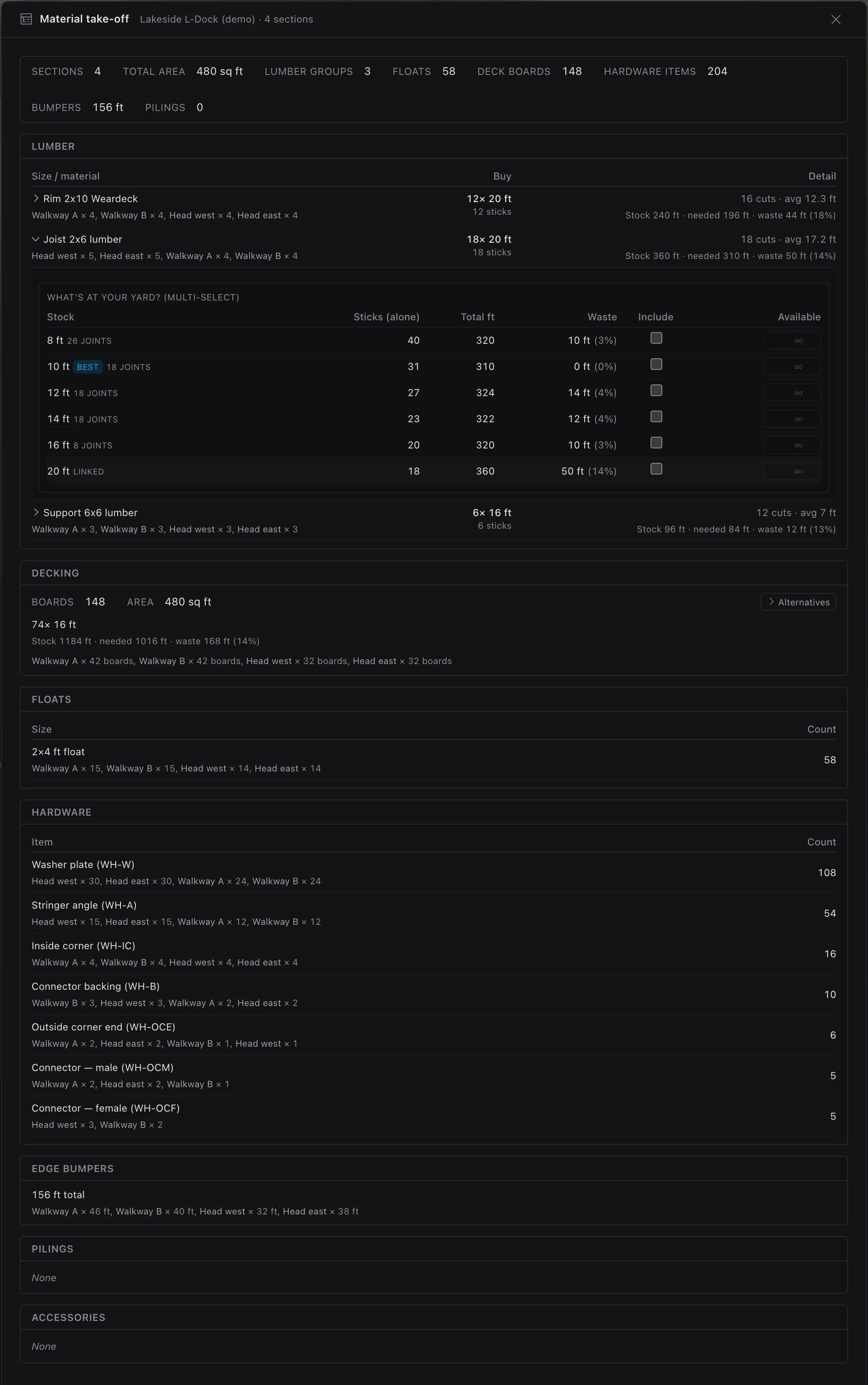
    Part of Dock Builder’s material take-off: 2x6 joists bought as 18 sticks of 20 ft, and the “What’s at your yard?” table comparing six stock lengths, with 10 ft marked best at 0% waste and the linked 20 ft stock at 14% waste.
    Lumber to buy, with the stock length that wastes least.
  3. Step 3: Send the same PDF to three builders

    Ask each to quote it as drawn and price any suggested changes separately.

    Plan page · Proposal Builder (demo)
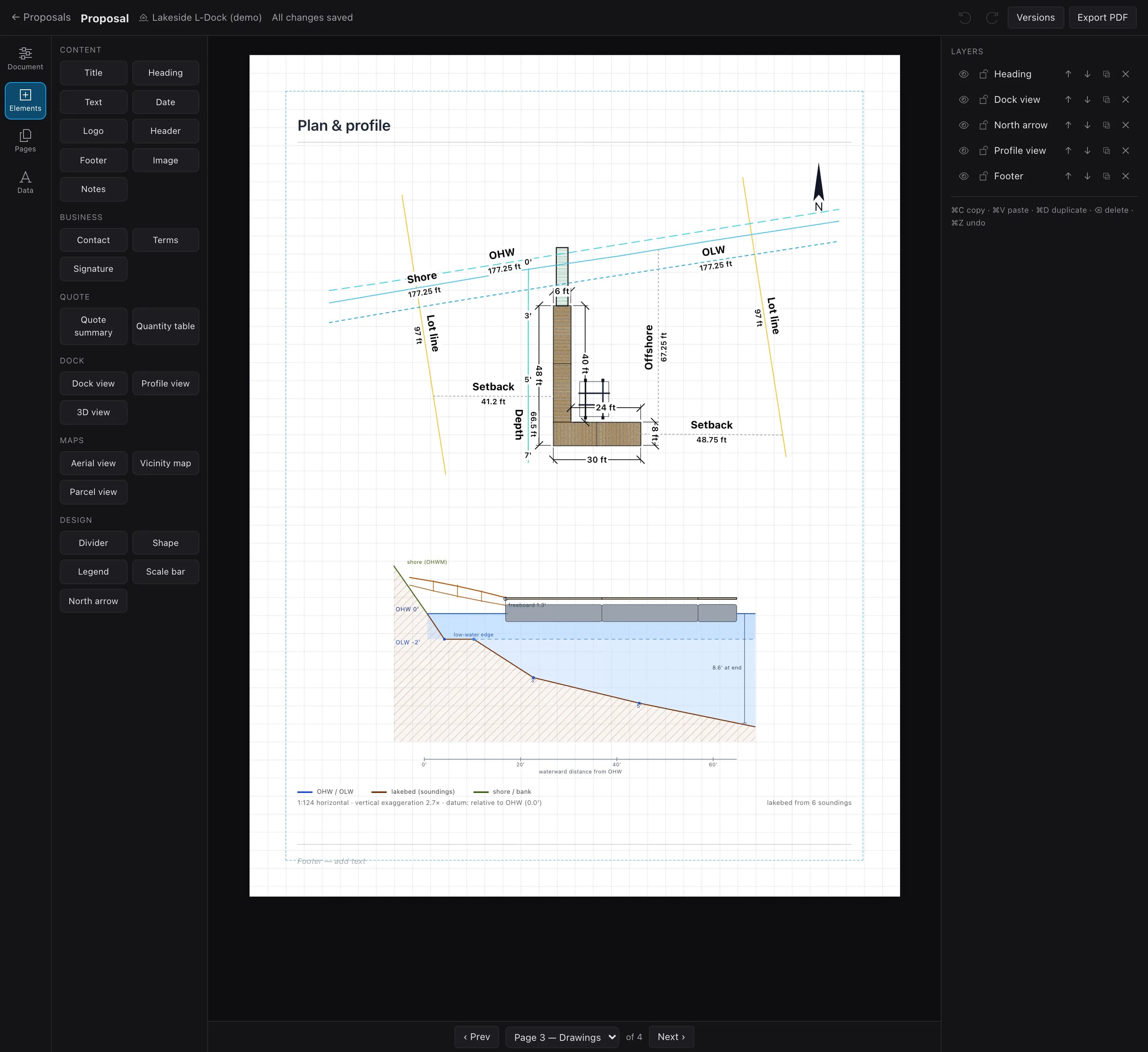
    A plan page made in Dock Builder’s Proposal Builder: the dimensioned L-shaped dock between two lot lines, with shore, high-water and low-water lines, setbacks of 41.2 and 48.75 ft, an offshore distance of 67.25 ft and a north arrow.
    The printable plan every builder quotes from.

Dock builders: give your customers this designer with your name on it

06

What the quote should itemize

A quote you can compare lists, at minimum: materials by category (framing, decking, floats or pilings, hardware), anchoring, labor, removal of any old dock, permits and drawings, electrical, lifts and accessories — plus the warranty, schedule, change-order rules and payment terms. Labor is often about half the cost of a dock[3], so a lump sum hides a lot. Line by line: what a dock quote should include.

07

Compare three quotes like-for-like

Walk down this list. What one builder includes and another leaves out explains most of the gap.

Quote comparison worksheet
  • Size and layout
    What to look for
    Your plan’s dimensions.
    Ask if it’s missing
    “Is this priced on my drawing?”
  • Support
    What to look for
    Float size and count, or piling count and depth.
    Ask if it’s missing
    “How many, what size, and why?”
  • Framing and decking
    What to look for
    Lumber size; decking material.
    Ask if it’s missing
    “What’s the decking, exactly?”
  • Hardware
    What to look for
    Galvanized or stainless.
    Ask if it’s missing
    “What will it look like in five years?”
  • Labor and equipment
    What to look for
    Install, barge, pile driving.
    Ask if it’s missing
    “Is labor a fixed price?”
  • Removal
    What to look for
    Old dock hauled away.
    Ask if it’s missing
    “Who hauls the old dock away?”
  • Permits and drawings
    What to look for
    Who draws, applies and pays fees.
    Ask if it’s missing
    “Who pulls the permit?”
  • Electrical and lifts
    What to look for
    Power, lights, lift capacity.
    Ask if it’s missing
    “Is a licensed electrician included?”
  • Warranty and schedule
    What to look for
    Written warranty; dates.
    Ask if it’s missing
    “What’s covered, for how long?”
  • Payment terms
    What to look for
    Deposit, progress payments, final payment.
    Ask if it’s missing
    “What’s due when?”

Then divide each total by the deck area. Example: three quotes for the same 200 sq ft floating dock at $5,400, $7,600 and $9,200 work out to $27, $38 and $46 per square foot. Angi and Fixr put floating docks at roughly $15 to $40 per square foot installed[3,4]. The $46 quote may include composite decking or removal the others left out, but it’s the one to ask about. And don’t pick the lowest bid automatically[1]. A planning number first? Try the dock cost calculator.

08

Payment schedules and financing

Tie payments to progress: a deposit, payments as work is done, and the final payment at completion. The FTC says never pay in full up front or before the work is done[1]. In California, a down payment can’t exceed $1,000 or 10%, whichever is less, and payments can’t run ahead of the work[2]. Ask your state consumer agency.

A progress-payment schedule — example structure
  • Deposit
    Triggered by
    Signed contract.
    Check before you pay
    Within any state limit.
  • Progress 1
    Triggered by
    Materials delivered or floats set.
    Check before you pay
    They match the quote.
  • Progress 2
    Triggered by
    Framing and decking complete.
    Check before you pay
    It matches the plan.
  • Final
    Triggered by
    Job complete; any inspection passed.
    Check before you pay
    Punch list done, warranty in hand.

Pay for work that’s done.

Payment plans and financing. If a builder offers a “payment plan” that runs past completion, that’s credit — get the APR, term, total cost and any prepayment penalty in writing. Dock financing usually comes from a lender: home equity, a personal loan, or a dealer’s lender program. Dock Builder doesn’t offer financing. Pay by check or card, so there’s a record.

09

Red flags

  • Door-to-door offers or pressure to sign today[1].
  • Cash only, or most of the price up front[1].
  • Asks you to get the permits yourself[1].
  • No written contract — or blanks left in it.
  • One lump sum, no line items.
  • No license or insurance certificate.
  • Can’t point you to docks they built a few seasons ago.
  • Far below the others — check whether the scope shrank.
Key takeaways
  • Draw the dock first and send every builder the same plan, so the quotes price the same thing.
  • Verify license and insurance, and look at docks each builder built a few seasons ago.
  • Compare quotes line by line, then per square foot; ask about anything only one includes.
  • Tie payments to completed work and keep the final payment until the job is done.
  • Get permits, warranty, schedule and change-order rules in the written contract.

Hiring a dock builder: FAQ

What is a dock builder?

A contractor who designs, builds and repairs docks — usually residential piers, floating docks and the lifts and accessories that go with them. Many also install and remove seasonal docks. Heavier waterfront work such as seawalls and commercial piers is usually marine-contractor territory.

How much does it cost to hire a dock builder?

Builders quote the job — materials and labor together — rather than an hourly rate. Floating docks run roughly $15–$40 per square foot installed, by Angi’s and Fixr’s figures, before lifts, electrical or removal of an old dock. Our dock cost guide and dock cost calculator break it down by type and material.

Do dock builders handle the permits?

Many do, but don’t assume. The contract should say who prepares the drawings, who applies and who pays the agency fees. See dock permits: what drawings you need.

How many quotes should I get?

Three is a practical number: enough to see a pattern without wasting everyone’s time. The FTC’s advice is to get multiple written estimates and not to pick the lowest automatically.

Can I design my own dock and have a builder build it?

Yes — that’s the approach this guide recommends. Draw the layout you want, then ask each builder to quote it and to suggest structural changes in writing. The builder (or an engineer) decides framing, spans and supports for your water.

Does Dock Builder build docks or recommend builders?

No. Dock Builder is dock design and quoting software. We don’t build docks, run a builder directory or sell your details. Some builders run our designer on their own websites, and a drawing you send through a builder’s site goes to that builder.

Sources

  1. 1.Federal Trade Commission — How to avoid a home improvement scam (accessed Oct 2026)
  2. 2.California Contractors State License Board — Learn about home improvement contracts (accessed Oct 2026)
  3. 3.Angi — How much does it cost to build a dock?. Floating docks $15–$40 per sq ft; permits $200–$2,000; labor about half the total (accessed Oct 2026)
  4. 4.Fixr — Cost to build a dock. Floating docks $15–$40 per sq ft; piling docks $20–$40 per sq ft; electrical $6–$8 per linear ft (accessed Oct 2026)
  5. 5.Washington Department of Fish and Wildlife — HPA application process (accessed Oct 2026)

Cost figures are planning ranges from the sources above, checked October 2026 — not quotes. Contractor and contract rules vary by state; this is general information, not legal advice.

Keep reading